In this article
When someone searches TikTok for a product, service, tutorial or local recommendation, they are looking for content that answers a specific question. For small businesses, appearing in relevant TikTok search results can create another way for potential customers to discover their products and services.
This is where TikTok SEO for small business becomes useful. Instead of relying only on trending sounds or random video ideas, businesses can research what people search for, create relevant videos and make their content easier to understand.
In this guide, you will learn how TikTok Search works, how to find useful keywords, how to use Creator Search Insights where available, and how to optimize videos for better search relevance without keyword stuffing or unrealistic growth promises.
What Is TikTok SEO?
TikTok SEO is the practice of making your videos, captions and topics relevant to the searches your intended audience makes on TikTok.
For example, imagine you own a clothing boutique in Dhaka. Potential customers might search for:
- How to style a cotton kurti
- Best casual outfits for summer
- Affordable women's clothing in Dhaka
- How to choose the right clothing size
Rather than publishing random promotional videos, you can create useful content that directly answers these questions.
The objective is not to repeat a keyword as many times as possible. It is to understand what people want to know and create a video that genuinely answers their search intent.
How Does TikTok Search Work?
TikTok provides search features that help users discover videos, creators and other content related to their interests.
According to TikTok's official explanation, several factors can influence search results, including:
- Content relevance: How well the content matches the search query.
- Hashtags: Hashtags associated with the video.
- Sounds: Audio associated with the content.
- User interactions: Previous searches and how users interact with videos.
- User information: Language preferences, location and device settings.
TikTok explains that content information, including how closely a video matches the search term, is generally weighted more heavily for most users in Search.
However, TikTok Search and the For You feed are not the same thing. The For You recommendation system also considers interactions such as watching, liking, sharing and skipping videos. Optimizing for Search does not guarantee For You distribution.
Read TikTok's official content recommendation explanation for more information.
Step 1: Understand What Your Customers Search For
Before creating videos, identify the questions your potential customers are already asking.
Think about your business from the customer's perspective. What problem are they trying to solve? What information do they need before buying something? Which products or services are they comparing?
For example:
| Business Type | Potential Search Query | Video Idea |
|---|---|---|
| Clothing Shop | How to style a cotton kurti | Three simple outfit combinations |
| Restaurant | Best biryani in Dhaka | Food preparation and menu highlights |
| Beauty Salon | Hair care tips for dry hair | Practical hair care routine |
| Electronics Shop | How to choose wireless earbuds | Features to compare before purchasing |
| Education Business | English speaking tips for beginners | A short practical English lesson |
These examples show how one business category can generate several useful video topics based on real customer questions.
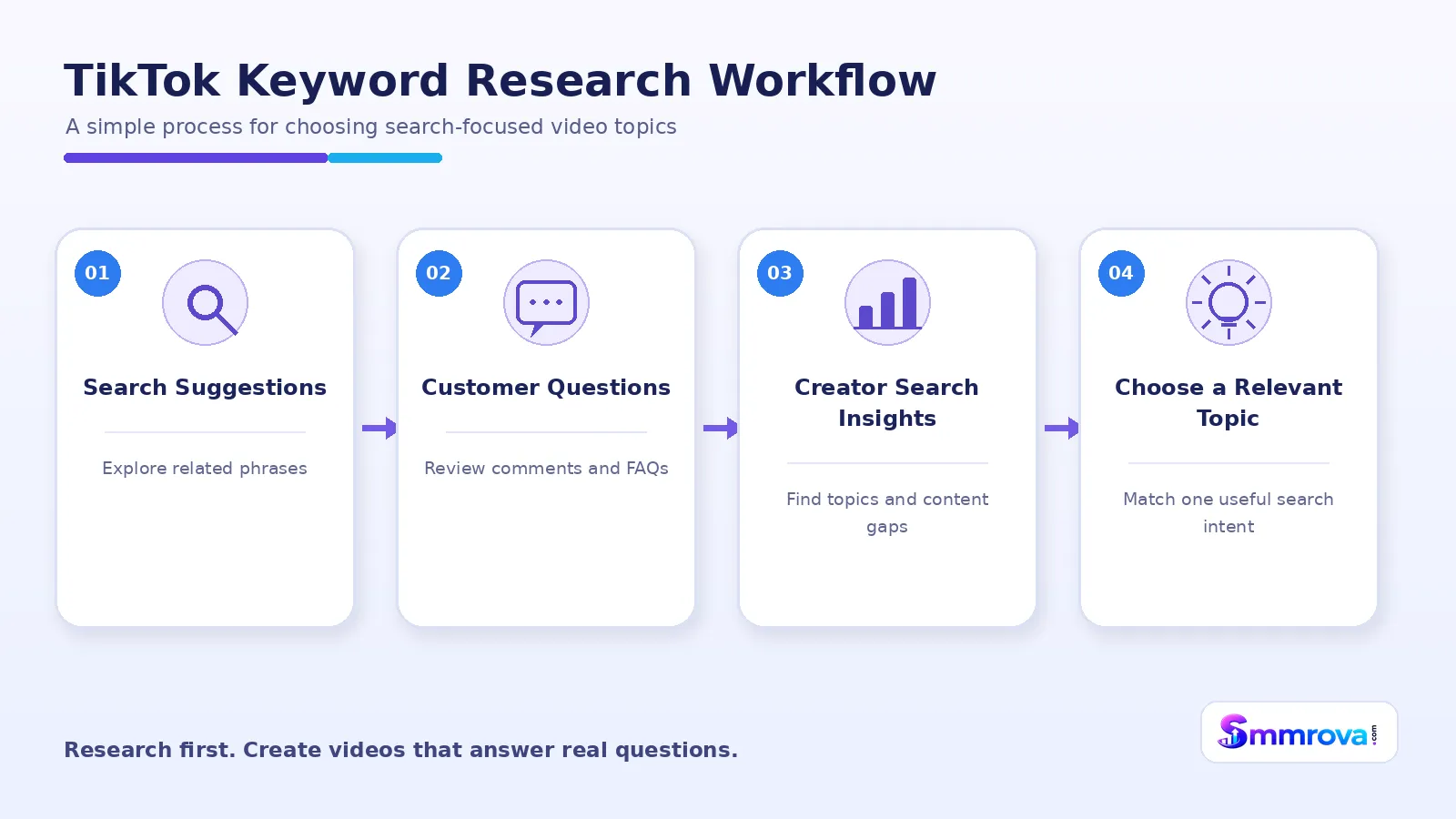
Step 2: Find TikTok Keywords and Video Topics
Keyword research helps you understand the language people use when searching for information. You do not need an expensive SEO tool to start researching TikTok content ideas.
1. Use TikTok Search Suggestions
Open TikTok and enter a broad topic related to your business in the search bar.
Pay attention to the suggested searches and related phrases that appear. These suggestions can provide ideas about how users phrase their questions.
For example, searching for a topic like skincare may help you identify more specific content ideas:
- Skincare routine for beginners
- How to apply sunscreen correctly
- Common skincare mistakes
- Daily skincare tips
Explore the relevant search results too. Look at the questions people ask in comments and identify information that existing videos do not explain clearly.
2. Explore Creator Search Insights
Creator Search Insights is an official TikTok tool designed to help creators discover topics that people search for on the platform.
According to TikTok, this feature can provide information about popular search topics and content gaps. A content gap refers to a topic that people are searching for but that does not have a large amount of related video content.
To explore the feature:
- Open the TikTok application.
- Go to the Search section.
- Search for Creator Search Insights.
- Open the feature if it appears for your account.
- Explore relevant topics, categories and available content-gap suggestions.
- Choose topics that are genuinely related to your business.
Important: TikTok states that Creator Search Insights is available in select regions. Its availability may depend on your location and account. If you cannot access it, use TikTok Search suggestions and customer questions as alternative research sources.
You can read more about this feature in TikTok's official Creator Search Insights announcement.
3. Use TikTok Creative Center for Trend Research
TikTok Creative Center provides tools for exploring trends and creative inspiration.
Its Trends section allows you to explore trending hashtags and review information such as related videos, regional popularity and trend performance.
Use it to identify relevant industry trends and creative ideas. However, remember that trending hashtags are not the same as verified organic search-volume data.
Explore the official TikTok Trends guide to learn how this feature works.
Step 3: Choose One Main Keyword for Each Video
A common mistake is trying to cover too many unrelated topics in one video.
Instead, choose one main search phrase and create a video that answers the question behind that phrase.
For example, a restaurant could create separate videos for:
- How to make chicken biryani at home
- What makes kacchi biryani different?
- How to choose a restaurant for family dinner
- Popular dishes to try at a local restaurant
Each video has a specific subject and a clear audience need.
You can also prepare a simple keyword planning sheet:
| Topic | Primary Search Phrase | Video Objective |
|---|---|---|
| Product Education | How to choose a cotton kurti | Explain product selection |
| Customer Questions | How to order birthday cakes | Explain ordering steps |
| Local Discovery | Best coffee shop in Dhanmondi | Introduce a local business |
Step 4: Optimize Your TikTok Video Content
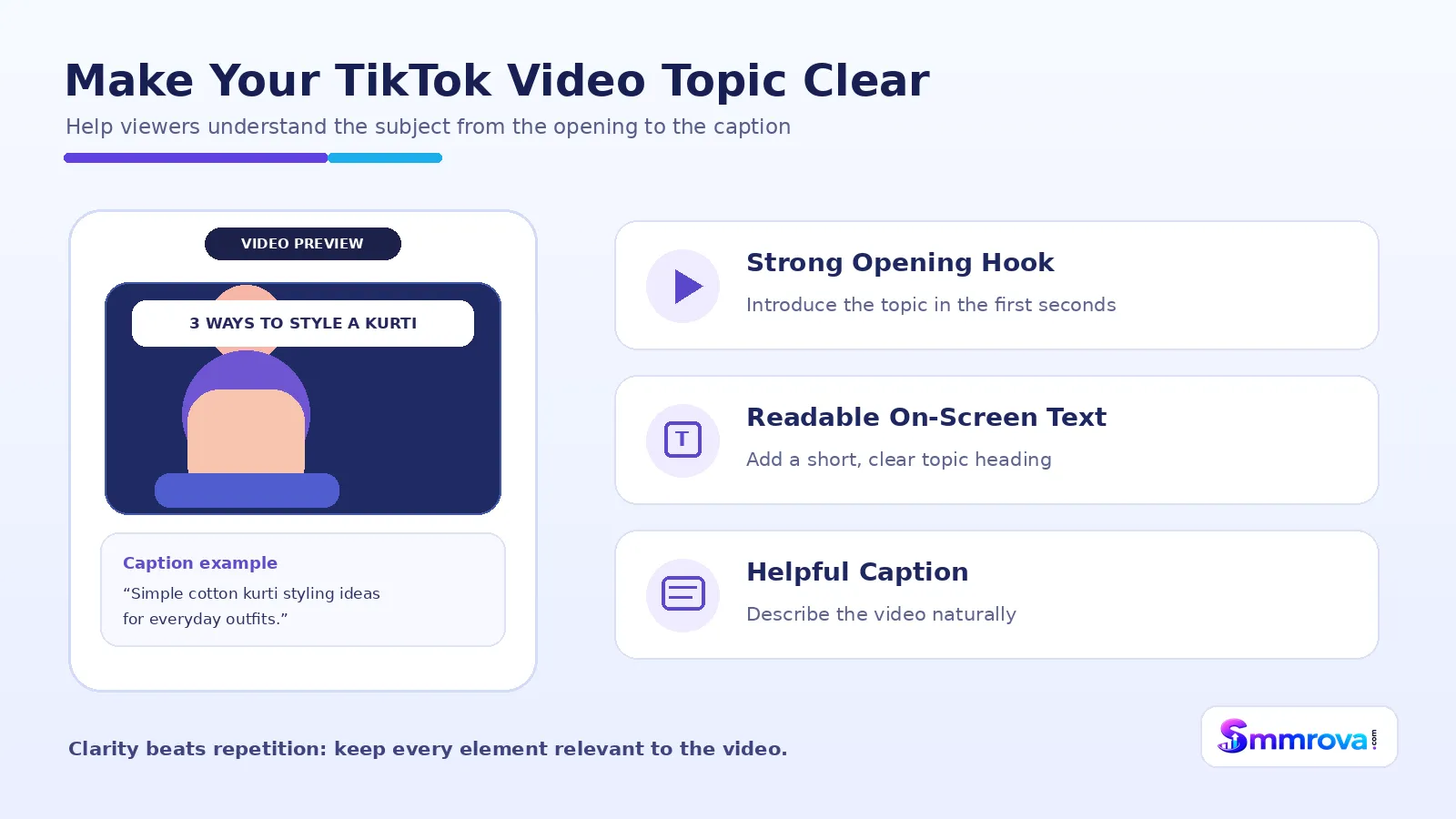
After selecting a topic, make sure the video communicates that topic clearly. Keyword research is useful only when the actual content answers the question.
Use the Topic Naturally in Your Opening
The first few seconds should help viewers understand what the video is about.
For example, instead of starting with a vague introduction, a clothing business might say:
Example: "Looking for simple ways to style a cotton kurti? Here are three combinations you can try."
This directly introduces the subject and establishes what viewers can expect.
Add Relevant On-Screen Text
Use a short heading that clearly describes the video topic.
For example:
- 3 Ways to Style a Cotton Kurti
- Beginner Skincare Mistakes
- How to Choose Wireless Earbuds
Keep text readable on mobile screens. Avoid displaying too many words or covering important visual details.
Write a Helpful Caption
Your video caption should explain what viewers will learn or see.
For a clothing store, a useful caption might be:
Example caption: "Looking for everyday cotton kurti styling ideas? Here are three simple outfit combinations for casual occasions."
Include your main search phrase naturally when it fits. Do not repeat the same keyword unnecessarily.
Clear spoken introductions, on-screen headings and captions improve the viewer's understanding of your topic. They are useful content practices, but TikTok does not publish a fixed keyword-placement formula that guarantees higher rankings.
Step 5: Use Relevant Hashtags and Sounds
Hashtags can help describe your video topic and are among the content factors TikTok identifies in its recommendation explanations.
Instead of using unrelated popular hashtags, choose a few that accurately describe your content.
For example, a local clothing business could use:
- #CottonKurti
- #KurtiStyling
- #FashionBangladesh
A restaurant might use hashtags related to its food, cuisine or location.
Sounds are another content-related factor identified in TikTok's documentation. Choose audio that fits the content and your business needs. Using a popular sound that has no connection to your video is not a substitute for relevance.
Businesses should also check the music-use permissions that apply to commercial content.
Step 6: Make Your Content Relevant to Local Customers
For small businesses, local relevance can be particularly valuable. A customer searching for a service in their area may need different information from someone searching for the same service generally.
Consider including useful local information when relevant:
- Business location or service area.
- Relevant neighbourhood or city name.
- Product availability.
- Price information, when accurate.
- Delivery or appointment details.
- Customer questions specific to your market.
For example, a bakery in Dhaka could make a video explaining how customers can select a birthday cake, what sizes are available and which areas it serves.
A local service provider could demonstrate a common problem, explain the service process and show the actual areas where the business operates.
Do not add unrelated city names or locations just to attract more searches. Every detail should accurately represent the business.
Step 7: Review Performance and Improve Your Content
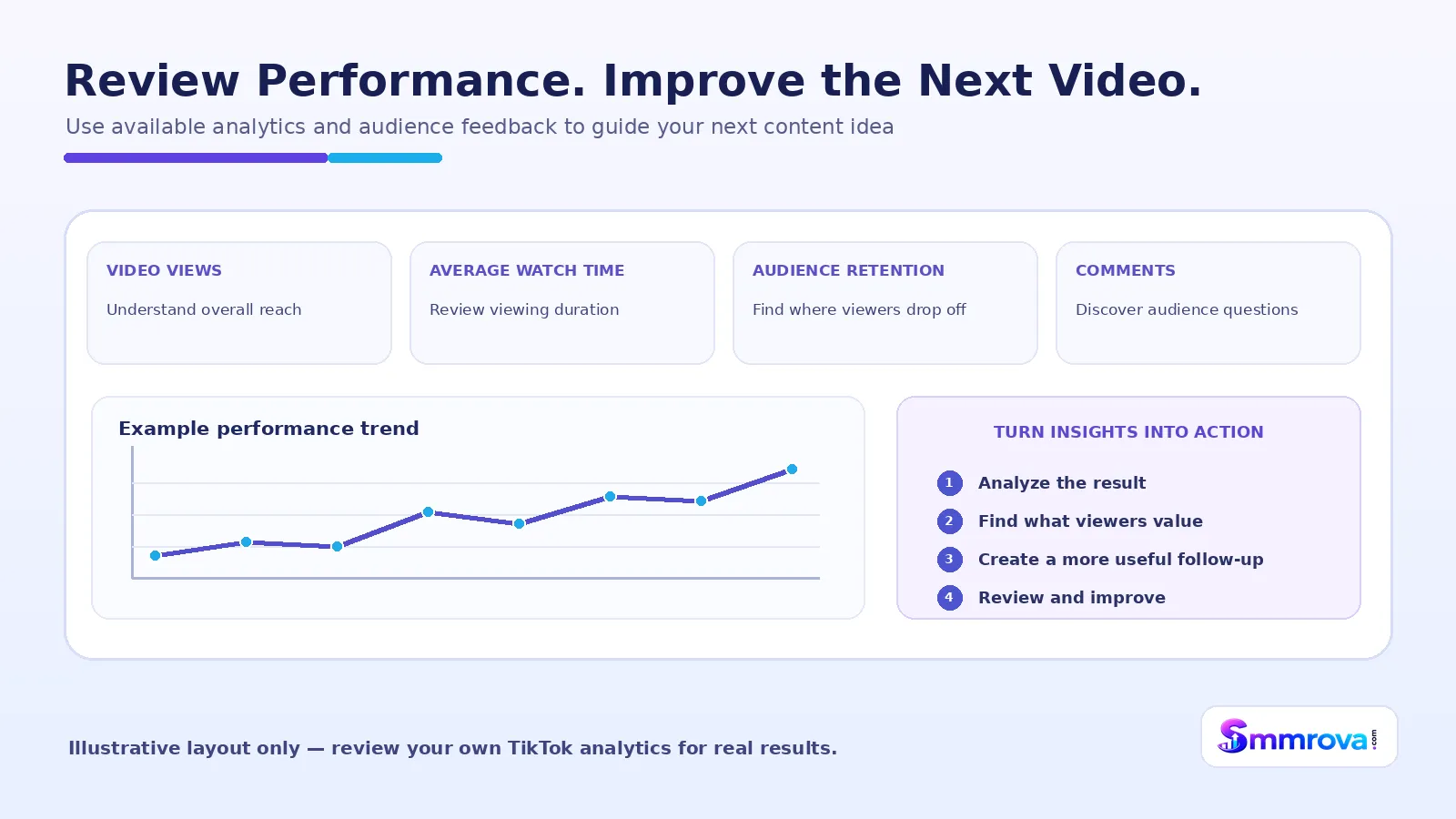
Publishing a video is not the end of the process. Review its performance to understand whether the content is helping your intended audience.
Use available TikTok analytics and feedback to review:
- Video views: Understand how many views your content receives.
- Average watch time: See how viewers respond to the video length and presentation.
- Audience retention: Identify parts where viewers may stop watching.
- Comments: Find common questions and requests for additional information.
- Shares and saves: Understand whether viewers find the content useful enough to revisit or share.
- Relevant search feedback: Where available, review how people discover your videos through Search.
TikTok's Comment Insights feature can also help creators understand common topics and questions in their video discussions where the feature is available.
Read the TikTok Comment Insights guide for more details.
Use these observations to improve future videos. For example, if people repeatedly ask about product sizing, create a dedicated video answering that question rather than repeating the same general advertisement.
Common TikTok SEO Mistakes Small Businesses Should Avoid
Optimizing for TikTok Search does not mean using every available keyword or copying whatever is currently popular. Avoid these mistakes:
1. Keyword Stuffing
Repeating the same search phrase in every sentence makes captions difficult to read. Write naturally and focus on the actual video subject.
2. Using Irrelevant Hashtags
Popular hashtags are not automatically suitable for your content. Choose tags that accurately describe the video.
3. Copying Every Trending Topic
A trend may be popular but irrelevant to your business. Focus on topics that match your customers' needs and your products or services.
4. Creating Videos Without a Clear Purpose
A video that attempts to discuss several unrelated topics can confuse viewers. Give each video one clear subject and objective.
5. Expecting Guaranteed Search Rankings
SEO is not a guaranteed placement system. Search results and recommendations can change, and audience interests vary. Artificial engagement or purchased views should not be treated as a shortcut to organic search relevance.
A Simple TikTok SEO Checklist Before Publishing
Use this checklist whenever you prepare a new TikTok video for your business.
- Have I identified a relevant customer question or search topic?
- Does the video answer that question clearly?
- Have I selected one main keyword or search phrase?
- Does the opening explain the video topic?
- Is the on-screen text easy to read?
- Does the caption describe the content naturally?
- Are the hashtags genuinely relevant?
- Is the location information accurate where applicable?
- Have I checked that the video provides useful original value?
- Do I have a plan to review feedback and improve future videos?
Frequently Asked Questions
What is TikTok SEO for small businesses?
TikTok SEO for small business means creating relevant videos around customer search queries and making their topics clear through useful content, captions and relevant hashtags.
How do I find keywords for TikTok videos?
Use TikTok Search suggestions, customer questions, comments and Creator Search Insights where available. TikTok Creative Center Trends can also help you explore relevant hashtags and trending topics.
Is Creator Search Insights available to every TikTok account?
No. TikTok announced that Creator Search Insights is available in select regions. Availability can vary, so check whether the feature appears in your account.
Do hashtags improve TikTok search visibility?
Hashtags are among the content information factors TikTok identifies in its recommendation explanations. Use relevant hashtags to describe your topic, but do not expect them to guarantee search placement.
Should I put keywords in every TikTok caption?
Include a relevant phrase when it naturally describes the video. Avoid keyword stuffing, repetitive captions and unrelated search terms.
Does TikTok SEO guarantee more views?
No. TikTok SEO can help make content more relevant to search queries, but it cannot guarantee views, rankings or For You distribution. Results depend on multiple factors, including content relevance and audience response.
Final Thoughts
TikTok SEO gives small businesses a practical way to approach content discovery with a clearer strategy. Instead of depending entirely on trends, understand your customers' questions, research relevant search topics and create videos that answer those questions.
Start with one main search phrase per video. Make the subject clear through your opening, on-screen text and caption. Use relevant hashtags, include accurate local information and review audience feedback regularly.
Most importantly, focus on creating original and genuinely useful content. A consistent approach to search-focused video planning can help your business build a more organized TikTok presence without relying on artificial engagement or guaranteed growth promises.
For a broader content planning approach, explore our guide on TikTok Marketing in Bangladesh on Smmrova.
 Up nextTikTok Content Calendar for Small Business: 30 Video IdeasTikTok · 14 min read
Popular TikTok services
Ready to grow your social media?
Create a free SmmRova account and pay with bKash, Nagad or Rocket. We never ask for your password.
Create Free Account View ServicesQuestions before you order? Message us on WhatsApp